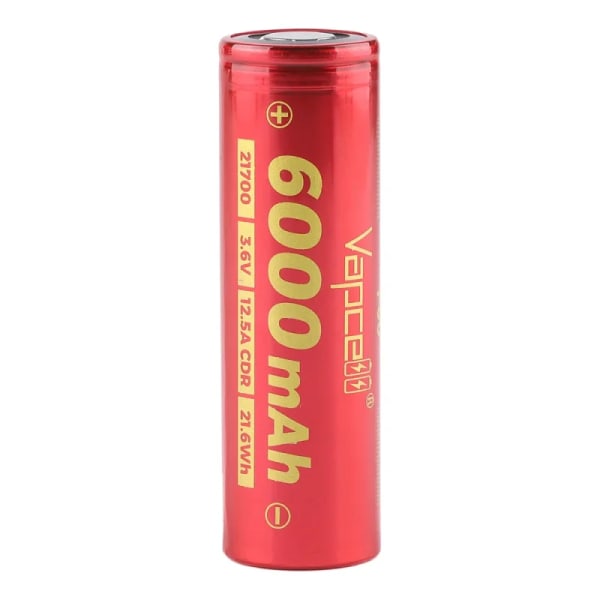


Three of the devices in this catalogue ship without a cell: the VOOPOO Drag X3, the VOOPOO Drag 5 Mod Kit and the VAPORESSO Armour Max Kit. This page is what they run on.
One number decides whether a cell is right for a mod, and it is not the one listings lead with. Capacity, the milliamp-hour figure, tells you roughly how long between charges. Continuous discharge rating, quoted in amps, tells you whether the cell can safely supply what the device asks for. Capacity is comfort. Discharge rating is safety.
The arithmetic, in one line
Safe watts equals continuous discharge rating, multiplied by the number of cells, multiplied by 3.2 volts, multiplied by 0.9. The 3.2 figure rather than 3.7 is deliberate: a regulated mod draws more current as the cell empties, so the sum has to hold at the bottom of the charge, not the top.
Read backwards, that gives you what each mod needs. Eighty watts from a single cell wants roughly 28A. A hundred and seventy-seven watts from two cells wants about 31A each. Two hundred and twenty watts from two cells wants around 38A each.
A dual-cell mod is gentler on each cell than a single-cell mod at the same wattage, which is counter-intuitive and worth knowing: wiring the cells in series doubles the pack voltage, so each one supplies half the current.
What the market claims, and what cells actually do
No 18650 exceeds about 30A genuine continuous discharge, and no 21700 exceeds 60A. Anything advertised beyond those figures is quoting a pulse rating or nothing at all.
Wraps are not evidence. One cell on this shelf carries 35A on its own wrap against an independently tested 20A, and the page states the tested figure. Treat the number printed on a rewrapped cell as marketing until a datasheet or a bench test agrees with it.
The Vapcell P42A 21700 4200mAh 30A Battery is a worked example of the same problem in reverse. Vapcell's own website lists the identical cell at 30A on one page and 45A on another, and the 45A comes from the maker's datasheet where it is temperature-limited rather than continuous. Independent testing puts it at 30A continuous, the UK trade has followed the tester rather than the datasheet, and so does this shelf. The lower of two published figures is not pessimism; it is the one that describes what the cell does all day.
Four of the six cells here suit gentle use rather than a mod at full power. The Efest IMR 18650 4000mAh 10A Battery, the Vapcell M35A 18650 3500mAh 10A Battery, the LG INR21700 M52V 5200mAh Battery and the Vapcell F60 21700 6000mAh 12.5A Battery all hold a great deal and deliver it slowly, between 7.5A and 12.5A. They are good cells; they simply do not clear the discharge threshold a vape mod at full power needs, and their pages say so instead of leaving you to work it out.
Two are built the other way. The Efest IMR 18650 3000mAh 20A Battery delivers 20A, and the Vapcell P42A 21700 4200mAh 30A Battery delivers 30A, and those are the cells for a mod being asked for real wattage.
Matched pairs, and the one genuine safety error
In a dual-battery mod, the two cells must be a matched pair: same make, same model, same age, charged and used together. Mixing cells is the one avoidable safety error on this shelf, because the stronger cell ends up carrying the weaker one and both age unevenly.
Beyond that, the ordinary care applies. A cell that has been dropped hard, dented, or has become warm in normal use should be retired. Damaged wraps should be replaced before the cell goes back in a device, not after.
Product and variant overview
Six cells: the Efest IMR 18650 3000mAh 20A Battery at 20A tested, the Efest IMR 18650 4000mAh 10A Battery, the Vapcell M35A 18650 3500mAh 10A Battery, the LG INR21700 M52V 5200mAh Battery at 7.5A, the Vapcell F60 21700 6000mAh 12.5A Battery at 12.5A, and the Vapcell P42A 21700 4200mAh 30A Battery at 30A.
Compatibility and related products
- The VOOPOO Drag X3 takes one 18650 or one 21700.
- The VOOPOO Drag 5 Mod Kit takes two 18650 cells as a matched pair.
- The VAPORESSO Armour Max Kit takes two 21700 cells, or two 18650 cells on the supplied adapter. It is the one device here with a stated cell requirement: 25A or better. The Vapcell P42A 21700 4200mAh 30A Battery is the only cell on this shelf that meets it.
- Every other device in the catalogue has a sealed internal battery and needs nothing from this page, the UWELL Caliburn A3 Pod Kit and the SMOK Nord 5 Kit among them.
Buying guidance
- Start from the wattage you actually run, not the wattage the mod can reach. Most people who own a 220W device spend their time well below it, and the cell requirement falls accordingly. A matched pair of Vapcell P42A supports around 173W of the Armour Max's 220W, which covers how almost anyone actually uses it.
- Match the cell to the discharge figure, then look at capacity. A high-capacity cell with a low discharge rating is the wrong choice for a mod, however good the milliamp-hour number looks.
- If you own an Armour Max, the Vapcell P42A 21700 4200mAh 30A Battery is the cell to buy. It is the only one here that clears the 25A minimum VAPORESSO specify, and the 18650 sleeves in its box still have nothing on this shelf that reaches that figure.
- Capacity and current pull against each other. The Vapcell F60 21700 6000mAh 12.5A Battery holds 6000mAh at 12.5A, and the Vapcell P42A 21700 4200mAh 30A Battery holds 4200mAh at 30A, and neither is better than the other except for a given job.
- Between the two ten-amp 18650s, the Vapcell M35A 18650 3500mAh 10A Battery is the better-evidenced capacity. Its 3500mAh sits at the established ceiling for the format and has been independently measured at that figure.
- Buy dual-mod cells in twos, from the same batch, and keep them together for the life of the pair.
- A charger, a two-cell carry case and a wrap-and-ring pack are not currently on this catalogue. Until they are, the handling advice on these pages has nothing to point at, and that is worth knowing before you order.
Kenya and Nairobi relevance
Cells ship the same day within Nairobi and nearby towns, and in 1 to 2 business days elsewhere in Kenya. Where a cell is being sent upcountry, the carry case matters more than it does across town; a loose cell in a bag with keys or coins is the classic way to short one.
Part of the wider Accessories shelf. Coils are on Replacement Coils and cartridges on Replacement Pods.